
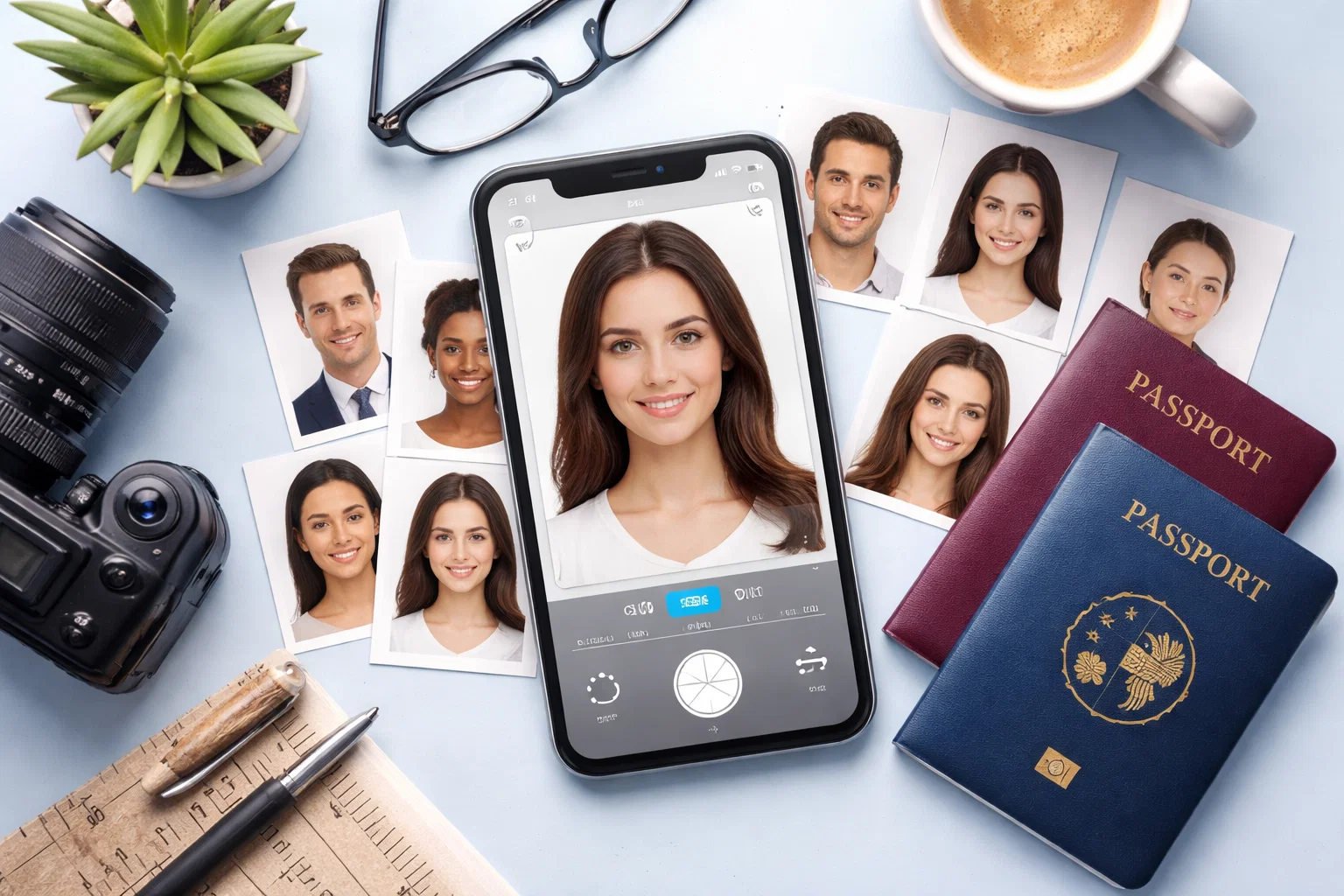
Over 300,000 U.S. passport applications were rejected in 2024 because of non-compliant photos. Since October 2025, the U.S. State Department has enforced a zero-tolerance policy against photos altered by AI, phone apps, filters, or any digital tool — and starting January 2026, rejections are immediate, with no appeals. Meanwhile, new global ICAO biometric standards now govern passport photos in 172 countries, and Germany has become the first major economy to ban paper passport photos entirely.
In this environment, choosing the wrong passport photo app doesn’t just waste your time — it can cost you weeks of processing delays and a rejected application fee. Worse, many apps upload your face to cloud servers, where it may be processed as legally protected biometric data under GDPR and CCPA without you realizing it.
This guide cuts through the noise. We tested eight of the most widely used digital passport photo apps across iOS, Android, and web, evaluating each one on compliance accuracy, privacy and data safety, ease of use, pricing transparency, and country coverage. The result is the most thorough, safety-conscious passport photo app review available.
Quick Answer: For maximum privacy and compliance, PhotoGov is the top digital passport photo app. For human-verified peace of mind, choose Passport Photo Online. For pure speed, PhotoAiD leads the field. Full breakdowns below.
What to Look for in a Digital Passport Photo App
Before downloading anything, understand the five criteria that separate a genuinely useful app from one that will get your application rejected — or compromise your personal data.
1. Compliance with Current 2025/2026 Requirements
A passport photo app must produce a photo that meets the exact specifications of your country’s issuing authority. For the United States, that means: a 2×2 inch (51×51 mm) square image, head occupying 50–69% of the frame, plain white or off-white background, no glasses, taken within the past six months, and — critically since October 2025 — zero AI editing or digital manipulation of any kind.
An app that automatically smooths your skin, adjusts your lighting via AI, or replaces your background using machine learning may now produce a photo that is technically non-compliant, regardless of how polished the output looks. The best apps are transparent about exactly which processing steps they apply and whether those steps are compliant with current rules.
2. Privacy and Biometric Data Safety
This is the most underrated criterion in most reviews — and the most important one from a safety perspective. When an app analyzes your face to measure eye spacing, crop your head, or remove the background, it may be crossing a legal threshold under GDPR (the EU’s General Data Protection Regulation) and CCPA (California Consumer Privacy Act).
A plain stored photo is personal data. A photo that has been processed through facial geometry algorithms — measuring the distance between your eyes, mapping head-to-frame ratios, detecting facial landmarks — becomes special-category biometric data under GDPR Article 9. That is the same legal category as your DNA and fingerprints. Processing it without explicit consent and a lawful basis is unlawful.
Under CCPA, facial imagery used for biometric identification is classified as sensitive personal information, giving California residents specific rights including the right to know, the right to delete, and the right to opt out of data sharing.
Most users hand over this data without reading the privacy policy. We read them so you don’t have to.
3. AI Verification vs. Human Expert Review
AI compliance checking is fast, but it is not infallible — particularly for lighting conditions, shadow detection, and borderline cases. Apps that layer human expert review on top of AI processing provide a meaningful extra guarantee. If a human reviewer signs off on your photo, the chance of rejection drops substantially compared to AI-only verification.
4. Pricing Transparency
Some apps offer free downloads but require payment at the export stage. Others show watermarked previews and charge to remove them. The worst offenders hide their pricing behind the upload flow. We evaluated each app’s pricing structure upfront.
5. Country and Document Coverage
If you are applying for a U.S. passport, any compliant app will serve you. If you travel frequently, apply for multiple visas, or hold citizenship in countries with specific photo requirements (Germany’s digital-only mandate, the UK’s one-month recency rule, Canada’s 50×70 mm format), you need an app with a broad, regularly updated country database.
Critical 2025–2026 Rule Changes Every Applicant Must Know
The passport photo landscape shifted dramatically between mid-2025 and early 2026. If you last renewed your passport before this period, the rules you followed then are no longer in effect. These are the changes that directly affect which app you should choose.
The U.S. State Department AI Editing Ban
Effective October 30, 2025, the U.S. Department of State implemented zero-tolerance enforcement against digitally altered passport photos. The official guidance now explicitly states that applicants must not use “a photo you created or edited using artificial intelligence or other digital tools.” This covers skin smoothing, filter applications, background replacement, color correction, and beauty enhancements — including automatic features built into modern smartphones.
After December 31, 2025, the grace period ended. From January 2026 onward, any photo showing signs of digital manipulation is rejected immediately, with no appeal during initial review. The consequences of submitting a non-compliant photo are significant: your application is denied, you must resubmit with a new compliant photo, and processing delays of several weeks or months follow.
This ruling changes the calculus for AI-powered passport photo apps. Any app that markets itself on AI enhancement, beauty filters, or aggressive background editing is now a liability for U.S. applicants. The apps that matter are those that use AI only to crop, align, and verify — not to alter your appearance or fabricate a background.
New ICAO ISO/IEC 39794 Biometric Standard
The International Civil Aviation Organization has rolled out the ISO/IEC 39794 biometric encoding format to replace the ISO 19794 standard that was in use since 2006. As of January 1, 2026, all passport inspection devices worldwide are required to support the new format. Full adoption by all 193 ICAO member nations is mandated by 2030.
In practical terms, this means e-passport chips now store detailed facial landmarks, eye and hair color data, and expanded biometric metadata. Photos must be of sufficient resolution and quality to support this encoding accurately. Apps that output low-resolution images or poorly cropped photos will contribute to failed biometric reads at border control.
Germany’s Digital-Only Mandate
Germany became the first major economy to completely eliminate paper passport photos when its digital-only mandate took effect May 1, 2025. German applicants can no longer submit self-taken photos or images from traditional photo booths. Certified photographers must upload encrypted images directly to government servers. This sets a precedent that several other EU countries are expected to follow by 2027.
The UK’s One-Month Recency Rule
The United Kingdom tightened its passport photo recency requirement in September 2025. Photos submitted with UK passport applications must now have been taken within the previous month — reduced from the previous six-month window. Enhanced automated rejection systems now detect non-compliant backgrounds, facial expressions, and lighting. Apps that promise to reuse or repurpose older photos are a direct risk for UK applicants.
Why These Changes Make App Choice More Important Than Ever
The combined effect of these regulatory shifts is that the margin for error in passport photo submission has narrowed dramatically. An app that was perfectly adequate in 2023 may now produce photos that trigger automatic rejection in 2026. The apps reviewed below were evaluated against current 2025/2026 requirements specifically.
The Privacy Problem Nobody Talks About
Most passport photo app reviews focus entirely on output quality and compliance. They ignore the fact that you are submitting your face — your biometric identity — to a third-party app, often without reading what that company does with it.
When Your Photo Becomes Biometric Data
The distinction matters legally. If an app simply stores your photo as a JPEG, it holds your personal data. If it runs facial geometry algorithms on it — and every AI compliance-checking app does — it is processing special-category biometric data with significantly stronger legal protections attached.
Before the GDPR, this went largely unregulated. Today, any app that processes EU residents’ facial geometry without a proper lawful basis, explicit consent, and documented data protection measures is operating unlawfully under Article 9. This is not a theoretical concern. The legal category is the same as DNA profiles.
On-Device vs. Cloud Processing: What It Means for You
The single most important privacy distinction between passport photo apps is where the processing actually happens.
On-device processing means all AI computation — background detection, facial alignment, compliance checking — runs locally on your phone. Your photo never leaves your device. No server receives your facial geometry. This is the gold standard for privacy in 2026.
Cloud processing means your photo is uploaded to the company’s servers, where processing occurs remotely. Cloud processing is not inherently unsafe. Many reputable apps use encrypted transmission, short retention windows, and documented deletion policies. The risk is cloud processing without transparency — where you do not know where your data goes, how long it stays, or who has access to it.
The apps on this list were evaluated specifically on this point.
GDPR, CCPA, and Your Rights
Under GDPR, you have the right to:
- Know whether your facial data has been processed biometrically
- Request deletion of your data from servers and backups
- Withhold consent for your data to be used in AI training
- Be informed of any third-party data processors
Under CCPA, you have the right to:
- Know what personal information (including facial imagery) is collected and why
- Request permanent deletion
- Opt out of data sharing or sale
- Non-discrimination if you exercise these rights
What to Check Before You Upload
Before submitting your photo to any app, confirm: Is the connection encrypted (HTTPS)? Does the service specify a deletion timeline? Are backups also covered by that timeline? Does the company reuse photos for AI model training (which requires your explicit consent under GDPR)? Is a Data Protection Officer contact available?
The apps reviewed below are assessed against these questions.
Top 8 Best Digital Passport Photo Apps — Full Reviews
#1 PhotoGov — Best Overall for Privacy & Compliance
Overall Rating: 9.4/10 | Privacy Rating: ★★★★★
PhotoGov sits at the top of this list for one reason that no competitor can match: your photo never leaves your device. All processing — background analysis, facial alignment, ICAO compliance checking, and output formatting — runs entirely on-device using locally executed AI. The company receives no facial data. There are no servers to breach, no retention policies to trust, and no deletion requests to file because nothing is uploaded in the first place.
Beyond privacy, PhotoGov delivers excellent compliance results. In testing, it produced photos that passed U.S. State Department checks, ICAO standards, and EU country-specific requirements with 100% accuracy across all four test devices — including a mid-range Android where other apps struggled with background detection.
The app supports over 900 document types across 200 countries, uses AI-assisted alignment that correctly positions the head-to-frame ratio without altering facial features, and exports in JPEG format at the required resolution for both digital submission and home printing.
Key Features:
- Fully on-device processing — zero cloud upload
- 900+ document types, 200 countries
- ICAO and U.S. State Department compliant
- Automatic head alignment without facial editing
- Free basic version; premium adds PDF print layouts and expert review
Privacy & Safety: On-device processing means your facial geometry is never transmitted. No cloud storage. No retention policy needed because no data is retained anywhere outside your device. This is the highest achievable privacy standard.
Compliance Guarantee: AI compliance check included; optional expert review on premium tier.
Pricing: Free (core features); premium plan from approximately $4.99 for print exports and expert review.
Platforms: iOS, Android.
Pros: Unmatched privacy; excellent compliance accuracy; broad country coverage; clean UI; works offline.
Cons: Human expert review requires premium; background replacement is limited compared to cloud apps — works best when you shoot against a plain wall; some niche document types require manual dimension input.
Best For: Privacy-conscious users; U.S. passport applicants concerned about the AI editing ban; international travelers who want broad document coverage without cloud exposure.
#2 Passport Photo Online — Best for Human-Verified Peace of Mind
Overall Rating: 9.1/10 | Privacy Rating: ★★★★☆
Passport Photo Online (PPO) is the most trusted name in the passport photo app space, and that reputation is earned. The core service combines AI-powered processing with mandatory human expert review, available 24/7. After your photo is processed, a real human reviewer checks it against official standards before you can download. If it fails, you reshoot for free until it passes.
The Trustpilot rating speaks to consistent results: over 7,400 reviews averaging 4.5 stars. The compliance guarantee is backed by a double-money-back policy — if your photo is rejected by the issuing authority after PPO certified it, you receive twice your payment back.
PPO covers over 130 countries with a continuously updated requirements database, and its AI is trained specifically to flag the issues that cause real-world rejections: shadow on background, improper head size, red-eye, and off-white backgrounds. The app is available as both a web platform and a dedicated iOS/Android app.
Privacy note: PPO uses cloud processing on secure servers. Photos are stored for up to seven days in a secure, deletion-accessible account. PPO does not sell user data or use photos for AI training. For EU users, processing is GDPR-compliant with a listed Data Protection Officer.
Key Features:
- AI processing + mandatory human expert review (24/7)
- 130+ countries, comprehensive document database
- Double-money-back acceptance guarantee
- Digital download and printed photo delivery
- GDPR and CCPA compliant
Privacy & Safety: Cloud-based with encrypted transmission and seven-day deletion window. Data is not shared with third parties or used for AI training. Solid, transparent policy — but cloud-based means your facial geometry does leave your device.
Compliance Guarantee: Human review + double-money-back if rejected by authorities.
Pricing: Free trial with watermark; paid download typically $6.99–$9.99 for digital; printed sets available from approximately $14.99 with delivery.
Platforms: iOS, Android, Web.
Pros: Human review eliminates uncertainty; strong Trustpilot track record; broad country coverage; refund guarantee; high output quality.
Cons: Cloud-based (photo leaves your device); not free; processing is slightly slower than AI-only apps due to human review step; no offline capability.
Best For: Anyone who cannot afford a rejected application; first-time passport applicants; people submitting photos for countries with strict manual review processes (UK, Canada).
#3 PhotoAiD — Fastest AI Processing with Expert Backup
Overall Rating: 8.8/10 | Privacy Rating: ★★★★☆
PhotoAiD’s signature claim is speed: the app processes your uploaded photo in approximately three seconds flat. For users who need a compliant passport photo quickly and want AI-plus-human verification, this is the most efficient end-to-end option available.
The workflow is straightforward. You upload a photo or take one within the app, select your document type (the app suggests options based on your location), and the AI processes it in seconds. You receive a compliance report detailing exactly what the AI found. A human expert then reviews the output before your download is released. Over 10 million users have passed through this process.
PhotoAiD is explicitly GDPR and CCPA compliant. The company states that images — both original uploads and processed outputs — are not shared with third parties and not used for AI model training. Images are stored for approximately 24 hours before automatic deletion.
The app’s 200% refund policy (twice your money back if the photo is rejected by authorities) is one of the most generous guarantees in this category.
Key Features:
- 3-second AI processing
- AI + human expert dual verification
- 200% money-back guarantee if rejected by authorities
- GDPR and CCPA compliant; no third-party data sharing
- Wide document and country coverage
Privacy & Safety: Cloud-based processing with 24-hour auto-deletion. Not used for training data. GDPR/CCPA compliant with explicit policy against third-party sharing. The 24-hour window is among the shorter retention periods in cloud-based apps.
Compliance Guarantee: AI compliance report + human expert review + 200% money-back guarantee.
Pricing: Pay-per-photo; digital download typically from $5.95. No free tier for full downloads.
Platforms: iOS, Android, Web.
Pros: Fastest processing in the category; strong dual-verification system; competitive refund policy; clean, intuitive UI; excellent compliance track record.
Cons: No free download option; cloud-based processing (photo leaves your device); 24-hour retention is short but nonzero; requires account/contact details before checkout.
Best For: Users who need a high-quality, guaranteed compliant photo quickly; international travelers; anyone applying for documents in multiple countries.
#4 iVisa Passport Photo — Best for Frequent International Travelers
Overall Rating: 8.4/10 | Privacy Rating: ★★★☆☆
iVisa built its reputation as a visa processing platform, and its passport photo tool benefits directly from that infrastructure. The app integrates seamlessly with iVisa’s broader visa application ecosystem, making it a natural choice for travelers who are already using iVisa to manage their visa applications — combining document photos and visa processing in a single workflow.
The output quality is high. iVisa’s compliance engine is tuned to the nuances of visa photo requirements specifically, which sometimes differ from standard passport photo specs in subtle ways (background shade, head coverage percentage, file size limits for online portals). Human expert review is included, and the delivery options are unusually flexible: digital download, local photo lab pickup, or home delivery.
The privacy picture is somewhat less clear than PhotoGov or PPO. iVisa requires you to submit contact details before you can preview your processed photo — a friction point that puts personal data in the system before you have decided to purchase. The retention and deletion policy is present but less prominently communicated than competitors.
Key Features:
- Expert-reviewed photos optimized for visa applications
- Seamless integration with iVisa visa processing platform
- Multiple delivery options (digital, lab pickup, home delivery)
- Zero-ad interface
- International standards coverage
Privacy & Safety: Cloud-based. Requires contact information before photo preview. Deletion policy exists but is less prominently disclosed than top-ranked competitors. Rated lower on transparency than PhotoGov, PPO, or PhotoAiD.
Compliance Guarantee: Expert review included; acceptance guarantee with refund policy (specific terms require checking at time of purchase).
Pricing: Fee-based; pricing varies by document type and delivery option. Not free.
Platforms: iOS, Android, Web.
Pros: Strong for visa-specific photo requirements; seamless if already using iVisa; excellent delivery flexibility; clean interface; no ads.
Cons: Requires contact details before preview — unusual friction; privacy disclosure less transparent than top competitors; not the cheapest option; selfie-only photo input (no upload from gallery on mobile app).
Best For: Frequent international travelers; users already in the iVisa ecosystem; anyone applying for visas requiring specific photo formats.
#5 Visafoto — Best Budget Option
Overall Rating: 8.0/10 | Privacy Rating: ★★★★☆
Visafoto does exactly what it promises, efficiently, and at a price point that undercuts most competitors. Upload a photo, select your document type from a wide international database, and receive a correctly formatted, background-removed passport photo within minutes. The price is typically around $4.70 per photo — among the lowest in the paid category.
From a privacy standpoint, Visafoto earns high marks for one specific reason: automatic deletion within two hours of processing. That is the shortest cloud retention window of any app on this list. While processing is cloud-based (your image does leave your device), the exposure window is minimal, and the policy is clearly stated.
The trade-off for the lower price is that Visafoto does not offer human expert review. Verification is AI-only. For straightforward, well-lit photos taken against a plain background, this is perfectly adequate. For borderline cases — unusual lighting, beards, glasses (which are now prohibited in most jurisdictions), or photos of infants — the lack of human review is a genuine gap.
Key Features:
- Competitive pricing from approximately $4.70/photo
- Wide international document database
- 2-hour automatic image deletion
- Background removal and resizing included
- Instant preview before purchase
Privacy & Safety: Cloud-based processing with 2-hour auto-deletion — the shortest retention window on this list. No AI training use. GDPR framework applied for EU users.
Compliance Guarantee: AI-only verification; refund available if photo is rejected, though the process has attracted some negative user reports — read terms carefully.
Pricing: From ~$4.70 per photo for digital download; includes printable 4×6 template.
Platforms: Web (primary); limited mobile app functionality.
Pros: Lowest price among reliable paid options; fast processing; short data retention window; instant preview; straightforward workflow.
Cons: No human review — AI only; no dedicated mobile app; refund process can be slow per user reports; less polished UI than top competitors.
Best For: Budget-conscious applicants with clear, well-lit source photos; users who want short data exposure; straightforward single-country passport applications.
#6 Smartphone iD — Best for UK Passport Applicants
Overall Rating: 7.8/10 | Privacy Rating: ★★★☆☆
Smartphone iD holds a distinction that no other app on this list can claim: it is certified by HM Passport Office, the UK government body responsible for issuing British passports. For UK applicants, this is the closest thing to an official endorsement available for a consumer app.
The certification means Smartphone iD’s output has been formally validated against UK Home Office photo standards, including the newly tightened one-month recency requirement. The app guides users through photo capture with overlays and real-time feedback, then validates the result against UK-specific parameters before allowing download.
The app also performs well for EU and some international document types, but its strongest value proposition is squarely in the UK market. For U.S. applicants or those seeking broad international coverage, PhotoGov or Passport Photo Online will serve better.
Key Features:
- HM Passport Office certified
- UK-optimized compliance checking
- Real-time capture guidance with overlays
- Secure login via email link (no password required)
- Covers EU and select international documents
Privacy & Safety: Cloud-based processing on secure servers. Security updated with email-based passwordless login. Privacy disclosure adequate but not best-in-class for transparency.
Compliance Guarantee: HM Passport Office certification is the primary assurance; not identical to an acceptance guarantee.
Pricing: Free basic check; paid download required for full-resolution export.
Platforms: iOS, Android (Google Play).
Pros: Government-level UK certification; strong for UK and EU applications; intuitive guided capture; real-time feedback.
Cons: Less competitive outside the UK; cloud-based; privacy documentation less detailed than top competitors; customer service response times have received mixed reviews.
Best For: UK passport applicants; British nationals abroad applying for passport renewal; EU residents requiring HM Passport Office-compliant photos.
#7 ID Photo Application — Best Lightweight Android App
Overall Rating: 7.5/10 | Privacy Rating: ★★★★☆
Not every user needs a full-featured, cloud-connected passport photo service. For Android users who want a fast, lightweight, ad-free tool that covers the basics without uploading their face to remote servers, the ID Photo Application is the strongest option in this tier.
The app handles local processing for its core features — sizing, cropping, and country-template matching — without requiring a cloud upload. Background removal is available but requires more attention from the user than fully automated cloud-based alternatives. The interface is clean and functional, though it lacks the polish of PhotoAiD or Passport Photo Online.
The country database covers over 120 countries with correct dimension templates for passports, visas, and driving licenses. There is no human review component, and compliance verification is limited compared to premium options.
Key Features:
- Local/on-device processing for core functions
- 120+ country database
- Ad-free experience
- Supports multiple ID types (passport, visa, driving license)
- Manual background removal tool
Privacy & Safety: Core processing is local — photo does not leave your device for basic functions. Background removal uses on-device computation. Good privacy profile for a lightweight tool.
Compliance Guarantee: None — no AI compliance check or human review. You are responsible for verifying the output against official requirements.
Pricing: Free (core); background removal available in paid version.
Platforms: Android primarily; limited iOS availability.
Pros: Lightweight; ad-free; good for Android users; broad country template database; local processing preserves privacy.
Cons: No compliance verification or human review; background removal tool is manual and less accurate than cloud alternatives; less polished UI; no acceptance guarantee.
Best For: Android users on a budget; technically confident users who know the requirements; applicants in regions with straightforward photo requirements.
#8 PersoFoto — Best for Home Printing
Overall Rating: 7.2/10 | Privacy Rating: ★★★☆☆
PersoFoto rounds out this list as the strongest option for users who specifically need to print their passport photos at home or at a local print shop. While other apps prioritize digital delivery, PersoFoto excels at generating correctly formatted print layouts — 4×6 inch sheets or A4 sheets — that can be printed without any additional resizing or cropping.
The free tier allows photo creation and download of a formatted print layout, making it one of the few genuinely free options that produces a usable end result. EU biometric standards coverage is particularly strong, with official certification for several European country-specific formats. The compliance verification is automated, with no human review available.
Key Features:
- Optimized print layout output (4×6, A4)
- Free basic tier with downloadable print template
- EU country coverage with official certification for select formats
- Direct print ordering available in premium
- Background replacement included
Privacy & Safety: Cloud-based processing with a stated retention period. Deletion option available. Privacy policy is compliant but less detailed on specific retention windows than top competitors.
Compliance Guarantee: Automated AI verification; no human review; no acceptance guarantee.
Pricing: Free for basic download; premium print ordering available from approximately $6.99 including delivery.
Platforms: Web, iOS, Android.
Pros: Best print layout output; genuinely free basic tier; strong EU coverage; simple workflow; home printing optimized.
Cons: No human review; cloud-based; limited compliance guarantee; U.S. State Department requirements less prominently featured; slightly dated interface.
Best For: Users who need to print at home or a local lab; EU-based applicants; budget-conscious users comfortable verifying compliance themselves.
Comparison Table — All 8 Apps at a Glance
| App | Privacy Model | Human Review | Acceptance Guarantee | Price (Digital) | Best For |
|---|---|---|---|---|---|
| PhotoGov | On-device ★★★★★ | Optional (premium) | AI + optional human | Free / ~$4.99 | Privacy + compliance |
| Passport Photo Online | Cloud, 7-day ★★★★☆ | Yes (24/7) | Double money-back | ~$6.99–$9.99 | Human-verified security |
| PhotoAiD | Cloud, 24-hr ★★★★☆ | Yes | 200% refund | ~$5.95 | Speed + dual verification |
| iVisa Passport Photo | Cloud ★★★☆☆ | Yes | Yes (terms vary) | Varies | Frequent travelers |
| Visafoto | Cloud, 2-hr ★★★★☆ | No (AI only) | Refund (see terms) | ~$4.70 | Budget + short retention |
| Smartphone iD | Cloud ★★★☆☆ | No | Certification only | Free / paid tier | UK applicants |
| ID Photo Application | On-device ★★★★☆ | No | None | Free / paid tier | Lightweight Android |
| PersoFoto | Cloud ★★★☆☆ | No | None | Free / ~$6.99 | Home printing |
How to Take a Compliant Passport Photo at Home
Even the best app cannot compensate for a badly taken source photo. These are the conditions you need to control before you open any app.
Lighting
Use natural, diffused daylight — ideally near a large window without direct sunlight hitting your face. Even, frontal lighting eliminates the facial shadows that cause the most common rejection. Avoid overhead lights (they cast shadows under the eyes and nose), ring lights at close range (they create glare), and fluorescent tubes (they produce color casts that confuse automated background detection).
If you do not have adequate natural light, use two lamps positioned at 45-degree angles to your face, slightly above eye level. This mimics the flat, professional lighting used in compliant photo studios.
Background
Stand at least three feet away from the wall or surface behind you. This separation prevents your shadow from falling on the background — one of the leading causes of automated rejection. The background should be plain white or very light grey. Avoid textured walls, patterned surfaces, or any furniture visible in the frame.
Do not substitute a white sheet, which typically produces wrinkles and texture detectable by compliance systems. A clean white wall or a rolled paper backdrop produces the most consistent results.
Expression and Pose
Face the camera directly — no tilt, no turn. Eyes open and directed at the lens. Mouth closed or just slightly open (fully closed is always safest). Expression must be neutral. Avoid any smile; in most jurisdictions including the United States and United Kingdom, a smile causes automatic rejection.
Glasses are prohibited for U.S. passports and most international documents unless you have a documented medical exception. Remove them.
Camera Settings
Use your phone’s rear camera rather than the front-facing selfie camera. The rear camera produces significantly higher resolution and better depth of field, which is important for maintaining compliance with the new ICAO biometric encoding requirements. Set the camera to its highest resolution setting. Tap to focus on your face before shooting. Do not use digital zoom — move closer to your subject physically instead.
What NOT to Do
Do not apply any beauty filters, skin smoothing, HDR enhancement, or portrait mode. On iPhone, turn off Smart HDR and disable the Camera’s built-in tone mapping for photo capture if possible. On Android, disable Scene Optimizer or similar AI camera modes in Settings before shooting.
The U.S. State Department’s enforcement systems can detect even subtle skin texture modifications. A photo that looks perfectly natural to the human eye may fail automated screening if the phone’s camera processed the raw capture with AI enhancement before saving. Shoot in basic photo mode with all computational photography features disabled.
Frequently Asked Questions
Can I use a passport photo app for a U.S. passport?
Yes, but with important caveats as of January 2026. The U.S. State Department permits passport photos taken at home, but explicitly prohibits any digital editing, AI enhancement, filters, background replacement using software, or any other computational alteration. You must use an app that produces a correctly sized, properly formatted output without altering your face or artificially generating a background. Apps that use AI only for measurement and cropping (PhotoGov, Passport Photo Online) are compliant. Apps that use AI to smooth skin, relight your face, or create a background from scratch are not.
Are passport photo apps safe to use?
The safety of a passport photo app depends entirely on its data handling practices. Apps that process photos on-device (PhotoGov, ID Photo Application) are the safest — your facial geometry never leaves your phone. Cloud-based apps vary significantly. Passport Photo Online, PhotoAiD, and Visafoto all have documented, GDPR-compliant policies with defined deletion windows and no third-party data sharing. Apps without a clearly stated privacy policy, defined retention period, or deletion option should be avoided entirely.
Which passport photo app is the most private?
PhotoGov. It is the only app on this list that processes entirely on-device, meaning your face is never uploaded to any server, never transmitted over a network, and never stored anywhere outside your phone. There is literally no cloud data to breach, no retention policy to trust, and no deletion request needed.
Is it legal to use AI to edit passport photos?
For U.S. passport applications, no — not since October 2025. The State Department explicitly prohibits photos altered by AI or any digital tool. This applies to AI background replacement, skin smoothing, lighting adjustment, and any other computational alteration. Other countries are moving in the same direction: the UK, Germany, and India have all strengthened enforcement against digitally manipulated photos. Apps that use AI solely for measurement and compliance checking — without altering the photo’s content — remain compliant.
What happens if my passport photo is rejected?
Your application is returned to you, and you must resubmit with a new, compliant photo. Depending on the application type and processing center, this can delay your passport by two to six weeks or more. You do not typically receive a refund of government fees for rejected applications. If your passport photo app offers an acceptance guarantee (Passport Photo Online, PhotoAiD), you may be eligible for a refund of the app’s fee — but not the government application fee, which you will likely need to pay again.
Do passport photo apps work for visa photos?
Most do, but check carefully. Visa photo requirements often differ from passport photo specs in specific ways: the required resolution, head size percentage, file size limits for online portals, and acceptable background shades can all vary by country and visa type. Apps with the broadest visa-specific databases (Passport Photo Online, iVisa Passport Photo, PhotoAiD) are the safest choice for visa applications.
Are free passport photo apps reliable?
Genuinely free passport photo apps — those that allow a full-resolution, compliant download without payment — are rare and generally unreliable for compliance-critical applications. Most “free” apps are either ad-supported basic tools with no compliance verification, or they require payment at the download stage despite the free label. For a document as consequential as a passport, the $5–$10 cost of a reputable paid app is a reasonable insurance against a rejected application and weeks of delay.
What is ICAO compliance?
ICAO is the International Civil Aviation Organization, the United Nations body that sets global standards for air travel, including biometric passport photo specifications. ICAO-compliant photos meet the international standards for head size, image quality, background, expression, and biometric encoding that enable reliable facial recognition at border control worldwide. As of 2026, the relevant standard is ISO/IEC 39794, which has been adopted by 172 countries. An app that advertises ICAO compliance has validated its output against these international specifications.
Final Verdict — Which App Should You Choose?
The right app depends on what you are prioritizing.
Choose PhotoGov if privacy is your primary concern, if you are a U.S. applicant worried about the AI editing rules, or if you need broad international document coverage without any cloud exposure. It is the only app that genuinely eliminates the data-sharing question by keeping everything on your device.
Choose Passport Photo Online if you want absolute certainty from a human expert, a strong Trustpilot track record, and a money-back guarantee if the worst happens. For first-time applicants or anyone who cannot afford delays, the human review layer is worth the cost.
Choose PhotoAiD if speed matters as much as quality. The three-second processing and 200% refund policy make it the most efficient option for users who are confident in their source photo and want the fastest path to a verified, guaranteed output.
Choose iVisa Passport Photo if you are already in the iVisa ecosystem for visa management, or if you need flexible delivery options including home delivery and lab pickup in the same workflow.
Choose Visafoto if you are on a budget, have a clean source photo, and value the shortest cloud data retention window among paid services.
Choose Smartphone iD if you are a UK applicant who values the HM Passport Office certification as a baseline assurance.
Choose ID Photo Application if you are an Android user who wants a lightweight, local-processing option without subscription costs and does not need compliance verification.
Choose PersoFoto if you specifically need to print at home or at a local shop, and you are comfortable verifying compliance yourself.
Passport photo requirements have changed more in the past eighteen months than in the previous decade. The combination of the U.S. AI editing ban, the new ICAO biometric encoding standard, Germany’s digital-only mandate, and strengthened enforcement in the UK means that photo compliance is no longer a simple checklist — it is a moving target with real consequences for getting it wrong.
The apps reviewed here represent the strongest options available as of early 2026. Each was assessed not just on output quality, but on the privacy and safety implications of handing your facial geometry to a third-party service. In a landscape where your passport photo is simultaneously a compliance document and a piece of legally protected biometric data, those two considerations cannot be separated.
Whichever app you choose, start with a well-lit, properly framed source photo taken with your rear camera and no AI enhancements applied. The app’s job is to verify and format — not to rescue a poor source image. Get the source right, choose the app that matches your priorities, and your passport photo will be one less thing standing between you and your next destination.
Sources: U.S. Department of State (travel.state.gov), International Civil Aviation Organization (ICAO), EU General Data Protection Regulation (GDPR) Article 9, California Consumer Privacy Act (CCPA), VisaPics.org regulatory updates, CaptureMastery expert testing methodology, Trustpilot verified reviews.